Frequent Questions
What Is Herpes?
Herpes Myths and Facts (updated)
Why is everyone still freaking out about Herpes? With HIV and Syphilis prevention and treatment funding constantly under attack, why does it seem that people are still most worried about Herpes? It’s because they don’t have the facts.
Myth: Herpes isn't that common, and I am unlikely to get it.
Fact: Herpes, or HSV, is very common and includes both Herpes Simplex Virus type 1 and Herpes Simplex Virus type 2 (HSV-1 or HSV-2). An estimated 80% of sexually active people have either HSV-1 or HSV-2. Most people with herpes will not have symptoms and therefore will not be aware they have it. Many people get HSV from partners who are unaware that they have it. These numbers can be confusing because the CDC reports a lower percentage, however they limit who they include in the data and which strain of HSV they’re reporting on.
Myth: HSV-1 always means Oral Herpes, and HSV-2 always means Genital Herpes.
Fact: If you have HSV-1 or HSV-2, you have herpes. Though HSV-1 most commonly causes "cold sores" on the mouth, you can get HSV-1 either orally or genitally, and you can get HSV-2 either orally or genitally. In fact, about 40% of genital herpes is caused by HSV-1. That means that if you have Oral HSV you can transmit to a partner’s mouth or genitals if you engage kissing or in oral sex. If you have Genital HSV you can transmit to a person’s mouth or genitals if you engage in oral or genital to genital sex (including anal sex).
- Having one form of either HSV-1 or 2 makes it more difficult to acquire the other form, however it is not a complete immunity. It is rare to have both though. Less than 10 percent of adults in the United States have both HSV-1 and HSV-2.
Myth: I don’t have anything. I’d know if I had Herpes.
Fact: About 80%+ of people with HSV don’t know they have the virus. They either do not have symptoms, or their symptoms are so mild they don’t notice them. Also, routine testing (even if you ask for a “full panel”) does NOT include HSV testing. Even if you insist, the tests aren’t very accurate unless there is an active sore that can be swabbed. Just because you’ve never been told you that you have HSV doesn’t mean you don’t have it.
Myth: People with herpes are always infectious.
Fact: A person with HSV is most infectious during an
outbreak, however the virus is occasionally shed from the skin when symptoms
are not present. This is called Asymptomatic Viral Shedding, but most of the
time when you don't have HSV symptoms you are not infectious. Taking
suppressive therapy medications, such as Valacyclovir and Acyclovir reduces
the length of outbreaks and also reduces transmission by up to 80% with daily
use. Unfortunately, many providers do not know, or fail to tell their
patients, about daily medication options.
Myth: If I’ve never had symptoms, I can’t transmit the
virus.
Fact: If you’re one of the lucky majority to never have
a symptom or outbreak, you can still transmit HSV through asymptomatic viral
shedding. Which is a big reason why it is so common. If you’re HSV positive,
you might consider taking daily suppressive medication to help protect
partners. Doctors have been slow to recommend this since HSV is generally
tolerated by most people, but it’s your body so advocate for what you decide
is best for you.
Myth: I will pass herpes to myself from my mouth to my
genitals if I accidentally touch myself.
Fact: Once you have herpes at one site, it is rare to
then get the same type at another site. This is because your body develops
antibodies which prevent this from happening.
Myth: HSV outbreak topical medicine, like Abreva, is
only for oral cold sores.
Fact: Topical medicines marketed for relief of outbreak
symptoms also help with genital HSV outbreaks. It’s just not marketed that
way because, well… sex stigma. Though majority of people feel relief from
medications like these, a small percentage can experience a burning sensation
orally or genitally. Try a little at first, and wash it off if it doesn't
feel better.
Myth: I shouldn’t have sex with anyone that has HSV.
Fact: With an estimated 80% of people having HSV, you’d
be excluding nearly everyone from your list of possible sexual partners, and
with an 80% chance that you already have HSV, that would exclude you from
other people’s lists of possible sexual partners. That is why the stigma is
so ridiculous, and needs to end. In fact, you are less likely to contract HSV
from someone that has HSV and takes daily suppressive medication. Most people
don’t know they have HSV, and many who do are not comfortable disclosing. If
a sexual partner says they don’t have HSV, there’s a 80% chance they do and
don’t know it. Many would argue that choosing a partner that knows and is on
medication is actually the safer choice.
Myth: If you have herpes, you should always wear
condoms for sex.
Fact: In monogamous, long-term relationships, most
couples choose not to continually use condoms, and understand that getting
herpes is often just a part of life. (You and Your partner likely already
have herpes without being aware of it). Whilst some people may experience
painful herpes symptoms from time to time, for the majority, herpes is not
symptomatic or causes only mild symptoms, and herpes medication is available
for those that need it. The vast majority of people tolerate HSV just fine.
That said, condoms do reduce the chance of HSV transmission by about 30%.
Condoms and dental damns combined with daily suppressive medications reduce
the risk of HSV by over 90%. Also keep in mind that condoms are great
prevention for other STIs like Gonorrhea, Chlamydia, Syphilis and HIV. Be
sure to talk to your partners about routine testing and STI status.
Myth: I just had an outbreak, and I’ve never had HSV
before. I know because I always get tested for STIs every six months. So this
means my partner cheated on me!
Fact: There is a very good change you already had HSV
and didn’t know it. Doctors, per CDC recommendations, do not routinely test
for HSV since it is so common and the vast majority of people tolerate it
just fine. There is also a chance that your partner (or you) already had HSV
and didn’t know, since 80% of people don’t know they have it. There's a good
chance your partner transmitted the virus to you unknowingly. However, if you
have other reasons to suspect your partner is cheating on you, don’t let
these facts stop you from having a conversation about the other suspicious
activity.
Sources and more information:
https://www.herpes.org.nz/patient-info/myths-vs-facts/
http://projectaccept.org/straight-dope-herpes-statistics/
https://www.self.com/story/10-myths-about-herpes-that-are-totally-false
https://www.ncbi.nlm.nih.gov/books/NBK47447/
https://www.niaid.nih.gov/news-events/nih-releases-strategic-plan-research-herpes-simplex-virus-1-and-2
https://www.onemedical.com/blog/live-well/herpes-facts
https://www.mdpi.com/1999-4915/15/9/1957
Dr. Leone, “Understanding Genital Herpes.”
Note: HSV can be problematic for pregnant people, and people with autoimmune disorders. They should talk to their doctors and partners. The VAST majority of people with HSV tolerate it just fine. This writing is a crib sheet for myths and facts, not an all-inclusive seminar.
Original Post
There are 2 main strains of Herpes - HSV1 Oral Herpes and HSV-2 Genital Herpes.
The herpes simplex virus (HSV) is categorized into 2 types: HSV-1 and HSV-2. HSV-1 is mainly transmitted by oral-to-oral contact, causing oral herpes (including symptoms known as cold sores), but it can also lead to genital herpes. HSV-2 is a sexually transmitted infection that causes genital herpes.
Studies show that about 1 in 7 Canadians carry the herpes simplex virus (HSV). It is very likely you have already encountered someone with the virus as not everyone knows they have it. It is important to know that herpes is extremely manageable and has little impact on day to day life. Having herpes does not mean someone is “unclean” or “unsafe” but it is important to communicate and be aware of the risks. Always ask more questions if you are not sure and don’t be afraid to do your own research.
Herpes can be carried orally, better known as cold sores, or genitally and both can be transmitted interchangeably. There’s no reason to panic though as the risk of transmission is very low as long as your partner is not having an active outbreak. Most people with HSV know what it feels like and won’t take any chances if they think they might feel an outbreak coming on.
Herpes Infections are only transmitted during an active outbreak when the contagious area of the skin contacts the mucous membrane or a crack in the surface of the other persons skin. Herpes can also be transmitted asymptomatically through viral shedding but this is much less common.
Please check out the fact sheet on transmission rates to get a better idea of the risk profile.
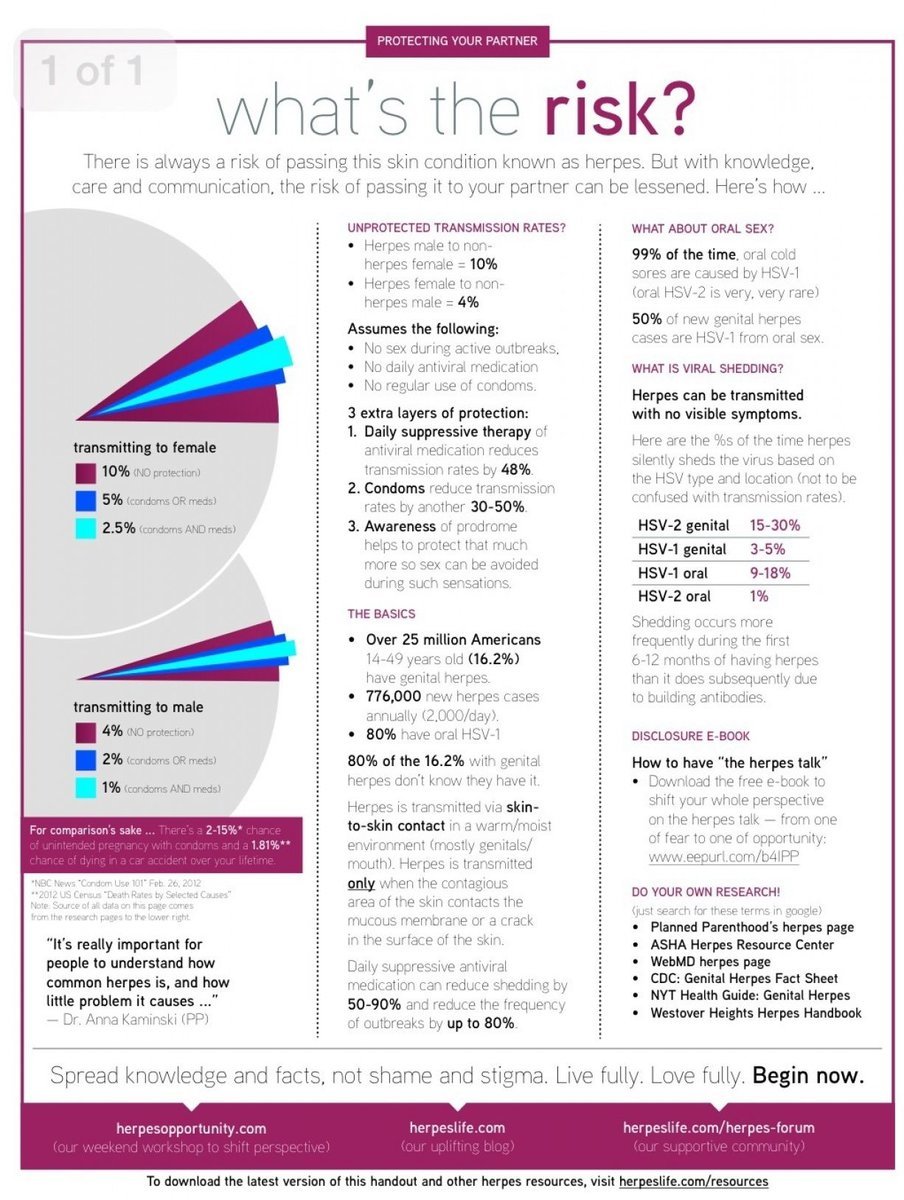
Very importantly, If you are not sure you are ok with the risks wait until you are sure.
Join The Party Return to FAQ Page